CPEC at Ten, the Kashgar to Gwadar Corridor Built Power Plants and an Empty Port
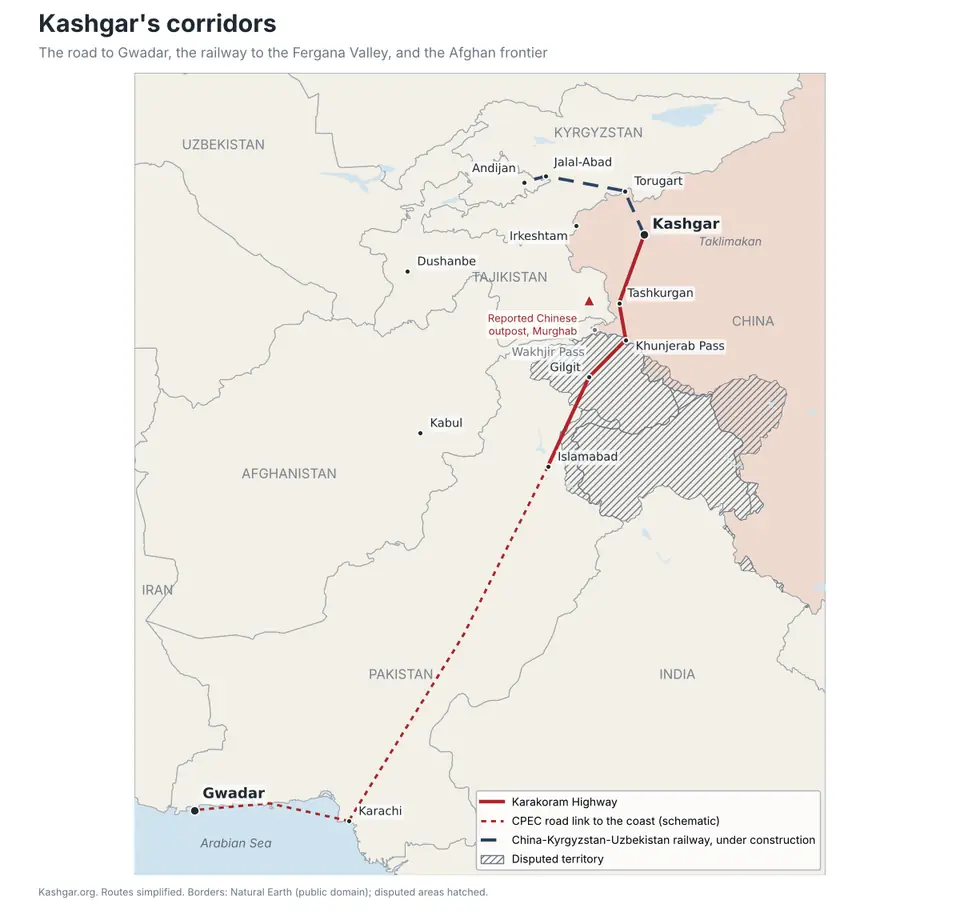
When Xi Jinping went to Islamabad in April 2015, the China-Pakistan Economic Corridor was sold as a road from Kashgar to the Arabian Sea. Chinese goods would come down the Karakoram Highway, cross Pakistan by road and rail, and ship out of Gwadar, cutting weeks off the voyage around India. The price tag was $46 billion. Two years later it was $62 billion.
Kashgar is the corridor's northern gate. It's worth asking, eleven years on, what came through it.
Not much.
Follow the money to the power stations
China's vice premier He Lifeng said in 2023 that $25.4 billion had actually been invested over the first decade. About $18 billion of it went into energy: 17 projects, mostly coal and power plants, with about 8,900 megawatts of capacity. Transport got about $6.7 billion. There's a fibre-optic cable from Khunjerab to Rawalpindi and a big new power line.
That's a power programme with Chinese lenders and Chinese contractors. It solved real blackouts in Pakistan. It also left Pakistan with bills it can't pay. By mid-2026 Pakistan owed about 423 billion rupees to the Chinese-built CPEC power plants, about 170 billion of it in late-payment charges, and Beijing refused to waive them. The World Bank puts Pakistan's debt to China at about $28.8 billion, more than a fifth of its external debt. In June 2025 China rolled over and refinanced $3.4 billion so Pakistan could meet an IMF target.
The railway was the heart of the trade story. ML-1, the Karachi–Peshawar line, was pledged in 2016 at $6.7 billion. Beijing never put up the concessional loan. In July 2026 Pakistan's economic affairs secretary told a Senate committee that ML-1 was no longer part of CPEC at all. Islamabad is talking to the Asian Development Bank instead.
A trade route that barely carries trade
At the top of the corridor, the Khunjerab Pass carries a trickle. A customs tally from the Pakistani side in March 2025 put the season's freight at about 12,400 tonnes. Irkeshtam, Kashgar's crossing into Kyrgyzstan, handled about 2 million tonnes in 2024, and a railway to Uzbekistan is now being built the same way.
At the bottom, Gwadar is close to empty. A Pakistani government brief in June 2026 counted 4,789 containers handled since the port opened, against a capacity of 240,000 a year, and no regular container line has ever called. Its free zone is 1.2 per cent occupied and employs fewer than 300 people, against 38,140 jobs promised. Under the concession, 91 per cent of revenue goes to the Chinese operator. China also paid for most of a new international airport in Gwadar, opened in October 2024, with a runway long enough for an A380 and a handful of flights a week.
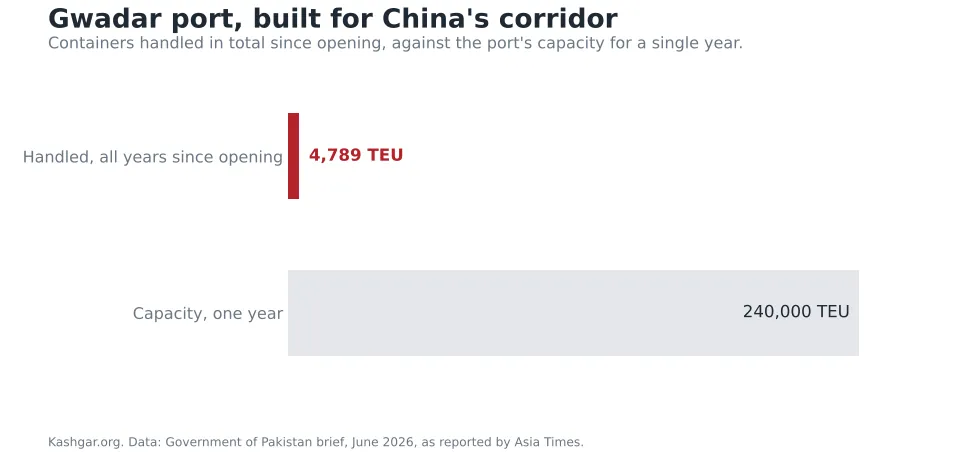
The corridor exists on the map. The goods mostly don't move along it.
Paid for in blood, and in silence
Chinese workers have died for this project. A bus bombing near the Dasu dam in 2021 killed nine Chinese. A woman suicide bomber killed three Chinese teachers at Karachi University's Confucius Institute in 2022. In March 2024 a car bomb on the Karakoram Highway at Besham killed five Chinese engineers. In October 2024 a bomb outside Karachi airport killed two more. Since 2021, by one count, 20 Chinese nationals have been killed in Pakistan. China's ambassador called it unacceptable, in public, which is rare.
Baloch separatists say the corridor takes their land and their coast. Beijing's answer is more security: Pakistani army units, special police for Chinese nationals, pressure for Chinese guards.
Pakistan pays in another way. In 2021 Imran Khan, then prime minister of the world's second-largest Muslim country, was asked about the Uyghurs. He said Pakistan respects the way China does things, that any concerns are raised behind closed doors, and asked why the West makes such an issue of it. Pakistan has kept that line under every government since.
The real cargo
Beijing launched "CPEC 2.0" in September 2025 with five new corridors on paper. Pakistan pledged again to protect Chinese workers.
The trade didn't come. What CPEC did deliver from Kashgar was a captive partner, one that owes China billions and won't say a word about the camps a few hours' drive from the corridor's starting point.
That's the return on the investment.