Kashgar Explained, Who Runs China's Westernmost City and Who Lives There
Kashgar sits in an oasis at the western edge of the Taklimakan desert, closer to Kabul than to Beijing. For two thousand years it was a market town on the routes between China, Persia and India, and for most of that time nobody in Beijing ran it.
The Kara-Khanids made it one of their capitals in the 12th century. Mahmud al-Kashgari, the city's most famous son, wrote the first great dictionary of the Turkic languages here in the 1070s. In 1865 Yakub Beg threw out the Qing and ruled Kashgaria as his own state until he died in 1877. On 12 November 1933 rebels outside the city proclaimed an East Turkestan republic. It lasted a few months before Hui warlord troops stormed Kashgar in February 1934. The Communists arrived in 1949 and have stayed.
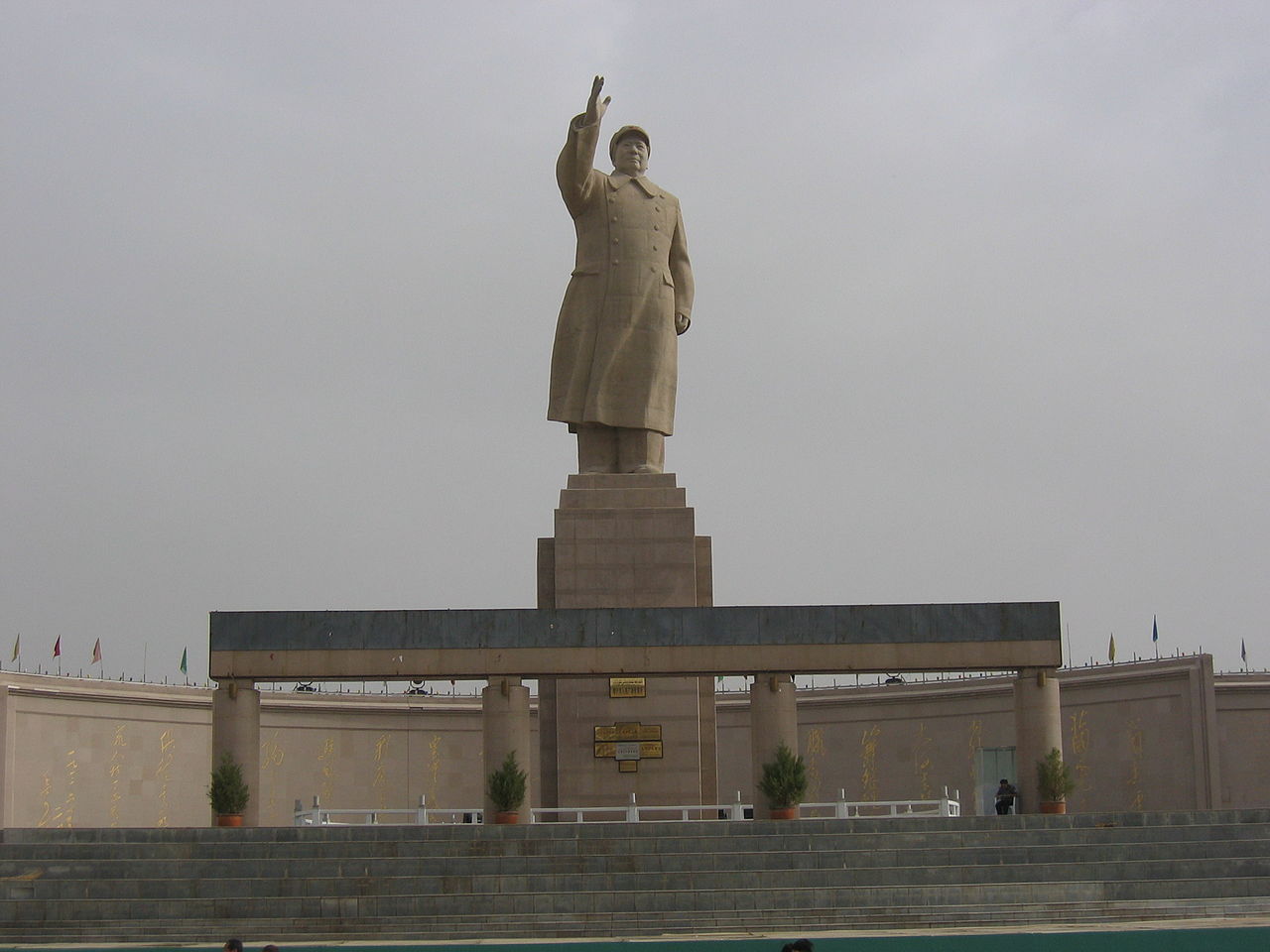
Photo: Nick Kent-Basham, Public domain, via Wikimedia Commons

A Uyghur city by the numbers
The 2020 census counted 4,496,377 people in Kashgar prefecture, the eleven counties and one city that the Chinese state calls Kashi. About nine in ten are Uyghur. The city itself had 782,662 people, part of that rise down to redrawn boundaries.
The trend runs one way. Between 2010 and 2020 the minority share of the prefecture fell from 92.0 per cent to 90.2 per cent. That looks small. Across Xinjiang the same decade added a quarter to the Han population, and migration did most of the work. In Kashgar the change is concentrated where it counts: in the new districts, the government offices, the police and the farms of the Xinjiang Production and Construction Corps.
The Corps is the clearest case. Tumxuk, set up in 1997 as the seat of its 3rd Division, is a city in its own right with its own mayor, who is also the division commander. Its two halves sit as enclaves inside Kashgar prefecture. In 2015 Tumxuk was 37 per cent Han. The prefecture around it was about 6.5 per cent Han.
The man in charge comes from the police
On paper Kashgar is governed by a Uyghur. Nijiati Niyaz is the prefecture's commissioner, the head of its administration. Look at his title more closely and he's also deputy party secretary. That means he answers to someone.
That someone is Nie Zhuang. He's Han, born in Jiangxi in 1972, and his whole career ran through public security. Before Kashgar he was executive deputy director of Xinjiang's Public Security Department. He became Kashgar's party secretary in 2022. In February 2025 Beijing also made him a vice chairman of the Xinjiang government, and he held both posts as of early 2026.
Go down the prefecture's own leadership list and the pattern repeats. The police chief, Gao Junqing, sits in the commissioner's office as a deputy commissioner. So does a front commander from Shenzhen's aid programme, the city that has sent more than two thousand cadres to Kashgar since 2010. The Uyghur name is at the top of the government page. The decisions come from the party committee and the security apparatus.
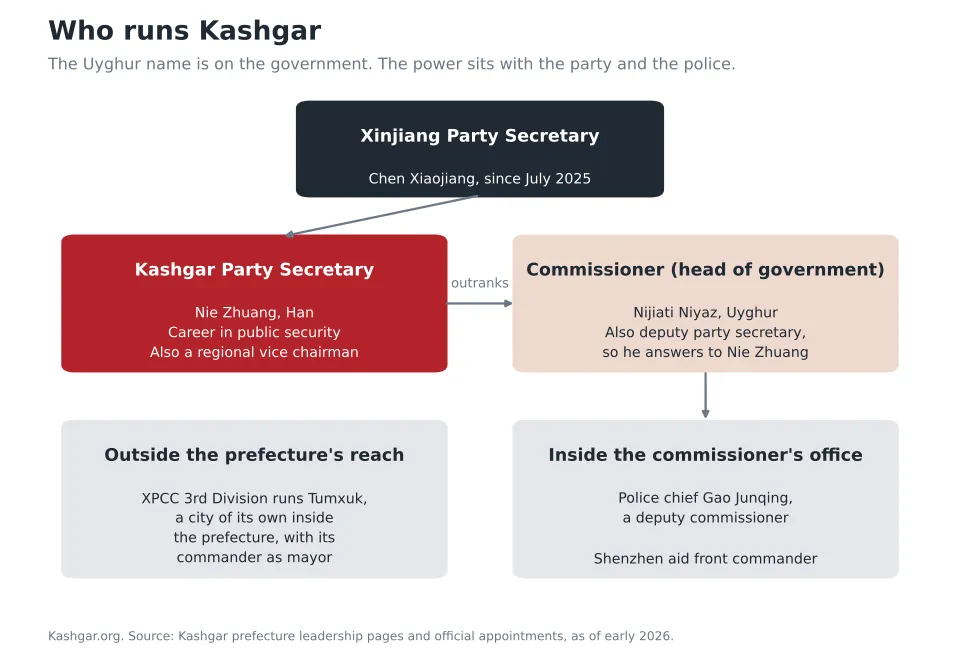
None of this is hidden. It's how autonomy works in Xinjiang. The ethnic quota fills the ceremonial post and a trusted Han official fills the one with power. Above them both, Xinjiang's party secretary since July 2025 is Chen Xiaojiang.
What the official figures leave out
Beijing likes to present Kashgar through growth numbers, and it has some. The prefecture's economy reached 175.2 billion yuan in 2025, up 6.4 per cent. Tourist visits came to 50.1 million, up almost a fifth in a year. A decade ago they were a few million.
Those numbers describe a place that has been rebuilt for visitors and policed for everyone else. They don't count the people taken to the camps after 2017, the men serving long sentences in the prisons that followed, the mosques closed or emptied, or the Old City knocked down and put back up as a ticketed scenic area. This site does.
Start with the governance chart. Ask who signs off, who carries a gun, and who gets to stand in front of the camera.
Then read the rest.