Uyghur Prisons After the Camps, Konasheher County Near Kashgar Jails One Resident in 25
In December 2019 Xinjiang's regional chairman told a press conference in Beijing that everyone in the camps had graduated. Some of them had. Many went somewhere else, and Beijing's own prosecutors kept count.
From 2017 to February 2022, Xinjiang's procuratorate prosecuted 540,826 people. In 2017 alone it was 215,823. Courts in the region convict more than 99.9 per cent of those who come before them, so prosecution is close to a sentence. The regional high court published one more number before it went quiet: 232,524 people sentenced in 2017 and 2018. Before 2017, about one sentence in ten was longer than five years. In 2017 it was 87 per cent.
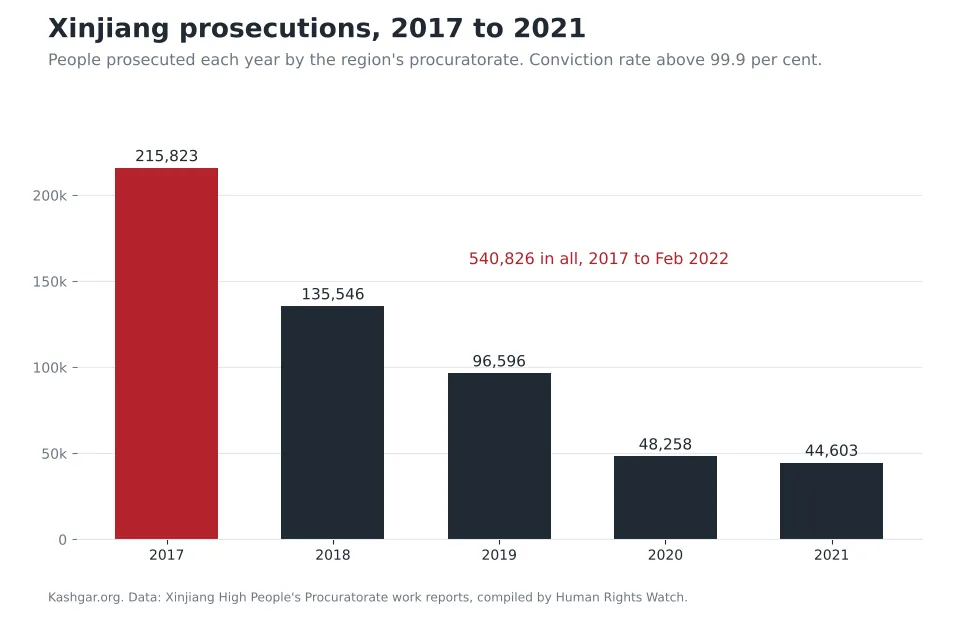
That's the system that followed the camps. It's harder to photograph, because it looks legal.
The most imprisoned county on earth
Konasheher, Shufu in Chinese, is the farming county that wraps around Kashgar city, with about 267,000 people. In 2022 a leaked list reviewed by the Associated Press named more than 10,000 Uyghurs from the county sent to prison, nearly one resident in 25. Sentences ran from 2 to 25 years and averaged nine. Most of them were arrested in 2017. AP worked out that this was the highest known imprisonment rate anywhere in the world, more than ten times that of the United States.
The charges were terrorism, extremism, "gathering a crowd to disturb social order". The people weren't bombers. One man got five years for religious extremism, though his cousin said he had no interest in religion. In January 2025 Radio Free Asia confirmed with local police that a woman from a village in the county, Seylihan Rozi, had been given 17 years for teaching Quranic verses to her own sons and a neighbour's boy, in lessons that took place between 2004 and 2008. Her sons got seven and ten years.
The same county is where the Xinjiang Police Files came from: 5,074 mugshots, a spreadsheet of 8,000 detainees and shoot-to-kill orders for anyone who tried to escape. See the camps post for those.
Half a million, still inside
Rights groups have added up the official counts. Human Rights Watch estimated in 2022 that about half a million people sentenced since 2017 were still in prison. The Uyghur Human Rights Project, working from procuratorate reports, put it at about 578,000 people prosecuted from 2017 to 2022, roughly 449,000 of them Uyghurs. That's more than one adult Uyghur in 17. Han Chinese across the country are imprisoned at a rate of about 80 per 100,000. For Xinjiang's minorities it's 3,814.
In February 2025 a report for the US Holocaust Memorial Museum by the historian Rian Thum found every policy behind the atrocity charges still running, and some expanding. It estimated detainees at more than half a million, with the state leaning more on pretrial detention centres, which it has kept building and enlarging since 2019. These are estimates, built from Beijing's own counts. Beijing stopped publishing the counts.
Kashgar's university leadership shows how far it reached. In September 2018 the president, a vice-president and two professors were removed at one meeting as "two-faced" officials. One of the professors was detained over an article she'd written about Uyghur culture. A Kashgar-born Turkology professor at Xinjiang University got ten years for separatism, reportedly for lectures and a conference abroad.
A prison sentence is still a camp
Beijing says these are lawful sentences for crimes, that no ethnic group or region is targeted, and that there has been no terrorist attack in years. Look at what the courts punished. A mother teaching her children to recite the Quran. Men meeting to share food and music. Phone apps, trips abroad, prayer.
Moving people from a camp to a prison doesn't make the detention lawful. It gives it a paper trail.
The camps closed. The people are still inside.