Kashgar Birth Rate Collapse, How Uyghur Births Fell and Then the Statistics Stopped
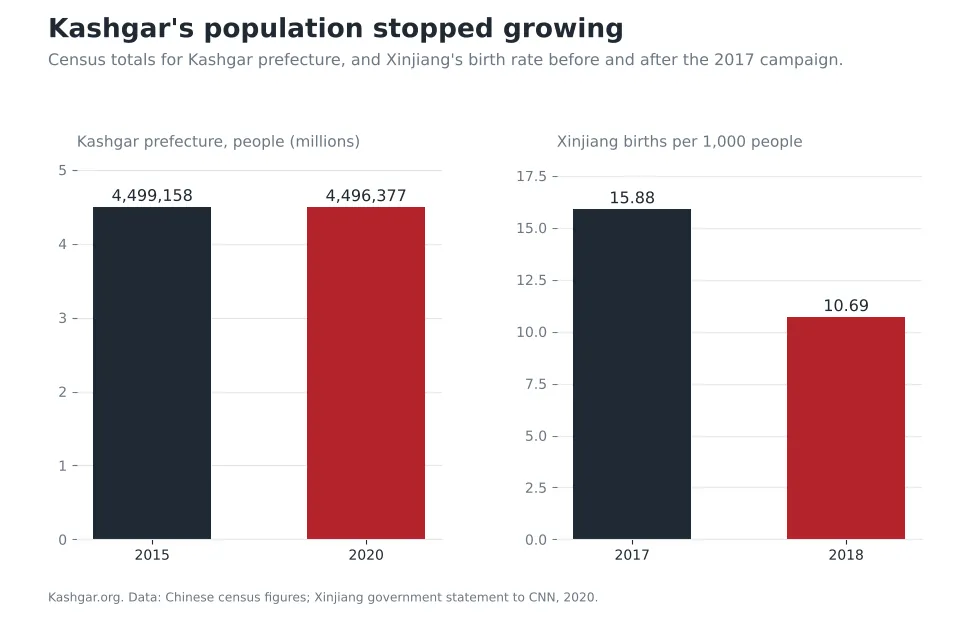
Here are two numbers from China's own censuses. Kashgar prefecture had 4,499,158 people in 2015. In 2020 it had 4,496,377. In five years, in one of the youngest and fastest-growing regions of the country, the population didn't grow at all.
Something stopped the babies. Beijing says it was development, later marriage and better family planning. The documents point to a campaign.
The steepest fall on record
Until 2017 Uyghurs in southern Xinjiang were allowed more children than Han Chinese, and they had them. Then the rules were enforced as never before. Fines for extra births were tripled in 2017. Women were sent to the camps for having too many children: in one leaked list from Hotan, 149 of 484 detainees were held for it. Local plans set targets for IUDs and sterilisations.
The results showed in the region's own yearbooks. Birth rates in Kashgar and Hotan, the two big Uyghur prefectures, fell by more than 60 per cent between 2015 and 2018, according to an AP analysis of official data. Across Xinjiang the birth rate dropped by almost half between 2017 and 2019, the sharpest fall anywhere in the 71 years of UN records, steeper than during the genocides in Rwanda or Cambodia. Han-majority counties held steady.
In 2018 Xinjiang fitted 963 new IUDs per 100,000 people. The national figure was 21.5. Sterilisations across the region rose about sevenfold between 2016 and 2018, to more than 60,000. A 2019 plan aimed to put more than 80 per cent of women of childbearing age in the rural south on long-term birth control. Kashgar prefecture spent 63.3 million yuan on family planning that year.
Different researchers measure the fall in Kashgar differently, depending on whether they use birth rates or natural growth and which years they pick. Every measure points the same way, and down hard.
Beijing admitted it, then stopped publishing
The government didn't deny the drop. In a fax to CNN in 2020, Xinjiang officials said the region's birth rate fell from 15.88 per thousand in 2017 to 10.69 in 2018, about 120,000 fewer babies, and put roughly 80,000 of them down to better implementation of family planning policy. That's Beijing's own estimate of births prevented by policy in one year.
Then the data went dark. In 2019 Kashgar stopped reporting its birth rate. Xinjiang's 2020 statistical yearbook left out key population figures for the first time. There's no reliable prefecture-level birth data for Kashgar since. A government that's proud of its record publishes it.
The official answer came in a 2021 white paper. It said the Uyghur population reached 11.62 million in 2020 and grew 1.67 per cent a year over two decades. That's true and it's beside the point. A twenty-year average buries a collapse that started in year eighteen. The same year, China's embassy in Washington tweeted that Uyghur women were no longer "baby-making machines". Twitter locked the account.
What the law calls it
In August 2022 the UN human rights office noted an "unusually sharp rise" in IUD insertions and sterilisations in Xinjiang. In December 2021 the Uyghur Tribunal in London, an independent panel chaired by the lawyer Sir Geoffrey Nice, found beyond reasonable doubt that by imposing measures to prevent births, China intended to destroy a significant part of the Uyghurs, and had committed genocide. It found no evidence of mass killing. It didn't need to. Preventing births within a group is one of the acts the Genocide Convention lists.
The researcher Adrian Zenz has projected that these policies could mean between 2.6 and 4.5 million fewer Uyghur births by 2040, and a much larger Han share in the south. Projections can be wrong. Kashgar's flat census line isn't.
Count the children who weren't born. Then ask why the counting stopped.